Last year, I was consistently late in planting seeds and seedlings. This year, I'm making a calendar to keep track of what I'm sowing when.
Kathy at Skippy's Vegetable Garden created a great program that will generate a planting calendar automatically, based on your average first frost date.
Kathy has two beautiful garden sites with lots of space and sun. I have a shady backyard and am growing in containers. Because our lists look so different, I created my own planting calendar, complete with some tips that I otherwise might forget (like thinning the spinach). Check it out.
I'm especially excited about the Mexico Midget tomatoes from Seed Savers Exchange. I am ordering these heirloom tomatoes as seedlings, so they will arrive ready to plant. Not only do I get to skip the labor-intensive process of starting them from seed, but also the hardening off. To accustom delicate seedlings to the outdoors, gardeners put them out for progressively longer periods each day, hardening them off over the course of a week. I find this near impossible to do correctly with a full-time job, so it's nice to have that burden relieved.
I'm also looking forward to growing as many alpine strawberries as possible this year. They caught my interest because they require less sun than their mainstream cousins. But since then, I've been reading about their delicious, intense flavor. I can't wait to snack on them while gardening.
What plants have you been drooling over in the seed catalogs?
Sunday, December 30, 2012


Monday, October 29, 2012
Harvest: What I Grew and What I Made


 | |||
| Three cloves of garlic |
 |
| Piles of oregano |
 |
| One calendula plant gave me a couple of handfuls of dried petals for a salve |
 |
| Three basil plants, including a couple of purple heirloom varieties |
| Cherry tomatoes and more calendula and basil |
 |
| Pole beans |
 |
| Tomato, basil, and goat cheese salad |
 | |
| Pickled green tomatoes |
 |
| Fried yellow tomatoes |
 |
| Pesto, which I froze in an ice cube tray and locked into a freezer Ziploc bag |
Wednesday, October 17, 2012
Size Matters (Containers Part 2)
 |
| A promising start with a sad ending |
This summer, I tried growing cherry tomatoes in a self-watering Trader Joe's container, 11" diameter, 11" deep. The plant didn't fruit and ended its sad life in the compost bin. My problem, I realized, was container size.
Obviously, big plants need big pots. But how big?
Container Size Recommendations
Jeff Gillman and Meleah Maynard, the authors of Decoding Gardening Advice, say that most vegetables need to be grown in a pot at least 20" wide and 16" deep. Their recommendations:
Most fruiting plants (such as tomatoes, beets, carrots, and peas)
20" diameter x 16" depth
Some less-thirsty fruiting plants (such as peppers, eggplant)
15" diameter x 10-12" depth
Greens (such as spinach, lettuce) and herbs
10" diameter x 10-12" depth
Jessie Banhazl at Green City Growers recommended slightly smaller minimums. She told me to plant fruiting plants in a minimum of 12 inches depth, or more for larger plants.
For tomatoes, zucchini, or summer squash
2 square feet
For cucumbers, eggplant, peppers, tomatillos, chard and collards
1 square foot
(I've also grown both peas and beans in square foot containers)
Consider the plant too, Jessie said. Leafy greens need more surface than depth to grow well. So a short windowbox is much better suited to arugula than to carrots.
For every plant there is a container
My grape beets were in a long, narrow plastic container only 8" deep. Their tap roots hit the bottom and they stopped growing. That container is now used for spinach and lettuce. And the Trader Joe's pot? My heirloom basil flourished in it for the rest of the summer.
Other Container Tips
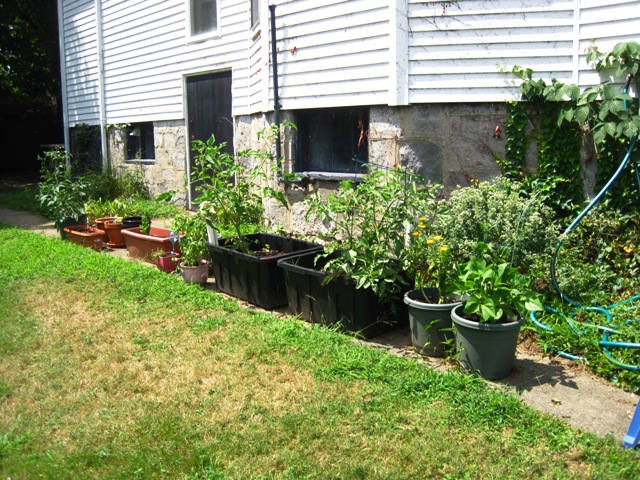
- Water (and drainage!) Everyone knows it's easy to forget to water your plants. But drainage is important too - I'll be drilling a few extra holes in one of my containers to avoid water-logged plants next year.
- Fertilizer: Frequent watering (or rainfall) will wash nutrients out of the soil. Remember to replace with an organic fertilizer, like compost tea or Neptune's Harvest.
Thursday, August 16, 2012
The Very Hungry Caterpillar
Let's set the scene of the crime.
August 4:
August 5:

Murder!
The usual suspects?
Flea beetles eat leaves, but I haven't seen them eat that quickly. They leave little holes that are perfect circles. Cabbage moths also eat leaves but leave ragged edges. Again, though, I haven't seen them eat a whole plant in a day. Maybe it was another creature with a voracious appetite...
When I looked closer, I saw a black head lift up out of the dirt, making a dash for the edge of the pot. I scooped it up and tossed it in the compost before I thought to get a picture. Fortunately, blogger and photographer Rob has taken some gorgeous pictures of various critters at http://www.robsplants.com/

And Rob even does his research. Please meet Spodoptera Ornithogalli, commonly known as armyworm (though it's actually a caterpillar). It's a truly elegant little creature, camouflaged black with racing stripes down its back. Apparently its good looks are enough to let it get away with murder. (Or, I'm just squeamish about killing anything larger than an ant.) Still, if it finds its way back to my basil pots, it will not survive to tell the tale.
What pests are you dealing with this summer? And on a scale of 1 to 10, how pretty are they?
August 4:
 |
August 5:
Murder!
The usual suspects?
Flea beetles eat leaves, but I haven't seen them eat that quickly. They leave little holes that are perfect circles. Cabbage moths also eat leaves but leave ragged edges. Again, though, I haven't seen them eat a whole plant in a day. Maybe it was another creature with a voracious appetite...
When I looked closer, I saw a black head lift up out of the dirt, making a dash for the edge of the pot. I scooped it up and tossed it in the compost before I thought to get a picture. Fortunately, blogger and photographer Rob has taken some gorgeous pictures of various critters at http://www.robsplants.com/

And Rob even does his research. Please meet Spodoptera Ornithogalli, commonly known as armyworm (though it's actually a caterpillar). It's a truly elegant little creature, camouflaged black with racing stripes down its back. Apparently its good looks are enough to let it get away with murder. (Or, I'm just squeamish about killing anything larger than an ant.) Still, if it finds its way back to my basil pots, it will not survive to tell the tale.
What pests are you dealing with this summer? And on a scale of 1 to 10, how pretty are they?
Saturday, July 14, 2012
Pickled Green Tomatoes
In my last post, a dying tomato plant resulted in a little less than a pound of green cherry tomatoes.

I wanted to pickle them, but wasn't in the mood to can. I found this great Italian recipe on Public Radio's Splendid Table for pickled green tomatoes, no processing required. I added some chopped onions because a lot of other pickling recipes call for them, and because I had them. The mint and hot pepper were out - I didn't have any on hand.
I sliced the tomatoes, laid them in a single layer, and sprinkled a bit of salt on top.
A layer of onions was followed by more tomatoes, each layer sprinkled with a bit more salt.
At this point, the plate was covered in saran wrap and went into the fridge for 24 hours. When I removed it, I rinsed the mixture with cold water.
I tossed the tomatoes and onions with minced garlic, minced sundried tomatoes (the dried kind, not the kind in oil), and some basil chiffonade. (I love that word. Makes me feel French.)
Aren't they pretty? I'll marinate for four days and then they're ready to be sauteed with vegetables or tossed into scrambled eggs. Yum!
What concoctions would you like to make this summer?
I wanted to pickle them, but wasn't in the mood to can. I found this great Italian recipe on Public Radio's Splendid Table for pickled green tomatoes, no processing required. I added some chopped onions because a lot of other pickling recipes call for them, and because I had them. The mint and hot pepper were out - I didn't have any on hand.
 |
 |
 |
At this point, the plate was covered in saran wrap and went into the fridge for 24 hours. When I removed it, I rinsed the mixture with cold water.
 |
 |
| Tomato mixture packed into jars and filled with 7% white vinegar. Result: 2 pints |
What concoctions would you like to make this summer?
Powdery Mildew
Look closely at the image below:

See the gray fuzz on those tomato leaves? I think that's powdery mildew. This is what it looks like when it's further along:

Yellow, withered leaves, curling up on the tomato plant. I attended a workshop at BNAN City Natives this morning and learned that the powdery mildew is unusual for most home gardeners in the Northeast right now, because it has been so hot. But because I have been growing these tomatoes in self-watering containers, they always have access to water. And so does the fungus that causes mildew. It doesn't help that my backyard is shady, getting maximum 5-6 hours of sunlight.
My fix:
I started by plucking the affected leaves, but this wasn't effective.
The mildew started to spread from its original hosts to its neighbors, so I decided to harvest the green tomatoes and pull the two plants most heavily affected.
Erica, garden educator at BNAN, recommended that I spray the less affected plants with a copper sulfate spray, available at hardware and gardening stores. She said to look for a spray certified by OMRI (Organic Materials Review Institute).
Prevention for mildew would be better drainage - next year, I will introduce more sand into the soil mix, and maybe drill a couple of extra drainage holes.
What diseases have you had in your garden and how do you deal with them?
See the gray fuzz on those tomato leaves? I think that's powdery mildew. This is what it looks like when it's further along:
Yellow, withered leaves, curling up on the tomato plant. I attended a workshop at BNAN City Natives this morning and learned that the powdery mildew is unusual for most home gardeners in the Northeast right now, because it has been so hot. But because I have been growing these tomatoes in self-watering containers, they always have access to water. And so does the fungus that causes mildew. It doesn't help that my backyard is shady, getting maximum 5-6 hours of sunlight.
My fix:
I started by plucking the affected leaves, but this wasn't effective.
The mildew started to spread from its original hosts to its neighbors, so I decided to harvest the green tomatoes and pull the two plants most heavily affected.
Erica, garden educator at BNAN, recommended that I spray the less affected plants with a copper sulfate spray, available at hardware and gardening stores. She said to look for a spray certified by OMRI (Organic Materials Review Institute).
Prevention for mildew would be better drainage - next year, I will introduce more sand into the soil mix, and maybe drill a couple of extra drainage holes.
What diseases have you had in your garden and how do you deal with them?
Saturday, July 7, 2012
Harvesting the Fruits of Spring
The seeds and seedlings I planted this spring are finally coming to fruition. Pun intended.

The garlic cloves I planted last November turned into fairly large bulbs, considering they're grown in a container. I had three. The third was delicious :)

I planted peas on April 16 (late) and harvested them July 5 (also late). Only one pea plant came up this year, probably because I planted the second in uncured compost. I got 7 pods, and a handful of peas. Their flavor was good but the texture a bit woody, so next time I will pay closer attention to the calendar and harvest earlier. This dwarf variety requires 65 days to mature, but I harvested them after 80.

I am also starting to harvest from two Red Robins. They are dwarf cherry tomato plants and heavy producers. The limbs were bowed over with the weight, but the plants are too short for my store-bought tomato cage, so I have a crazy staking scheme to keep them out of the dirt.

Of course, every harvest should end in a meal. With a bit of olive oil and salt, I made myself a summer salad.

What are you harvesting from your garden this season?
The garlic cloves I planted last November turned into fairly large bulbs, considering they're grown in a container. I had three. The third was delicious :)
I planted peas on April 16 (late) and harvested them July 5 (also late). Only one pea plant came up this year, probably because I planted the second in uncured compost. I got 7 pods, and a handful of peas. Their flavor was good but the texture a bit woody, so next time I will pay closer attention to the calendar and harvest earlier. This dwarf variety requires 65 days to mature, but I harvested them after 80.
I am also starting to harvest from two Red Robins. They are dwarf cherry tomato plants and heavy producers. The limbs were bowed over with the weight, but the plants are too short for my store-bought tomato cage, so I have a crazy staking scheme to keep them out of the dirt.
Of course, every harvest should end in a meal. With a bit of olive oil and salt, I made myself a summer salad.
What are you harvesting from your garden this season?
Subscribe to:
Posts (Atom)